Introduction
As businesses increasingly embrace digital transformation, CRM automation has become an essential component of modern sales strategies. If you’re exploring broader automation opportunities, check out our guide on AI Automation Explained: Everything Business Owners Need to Know.
In today’s highly competitive business environment, sales teams are expected to generate more leads, close deals faster, and deliver exceptional customer experiences. However, many organizations continue to rely on manual processes that consume valuable time and reduce efficiency. Administrative tasks such as updating customer records, sending follow-up emails, managing spreadsheets, and tracking interactions often prevent sales professionals from focusing on what truly matters—building relationships and closing deals.
This is where CRM automation becomes a game-changer.
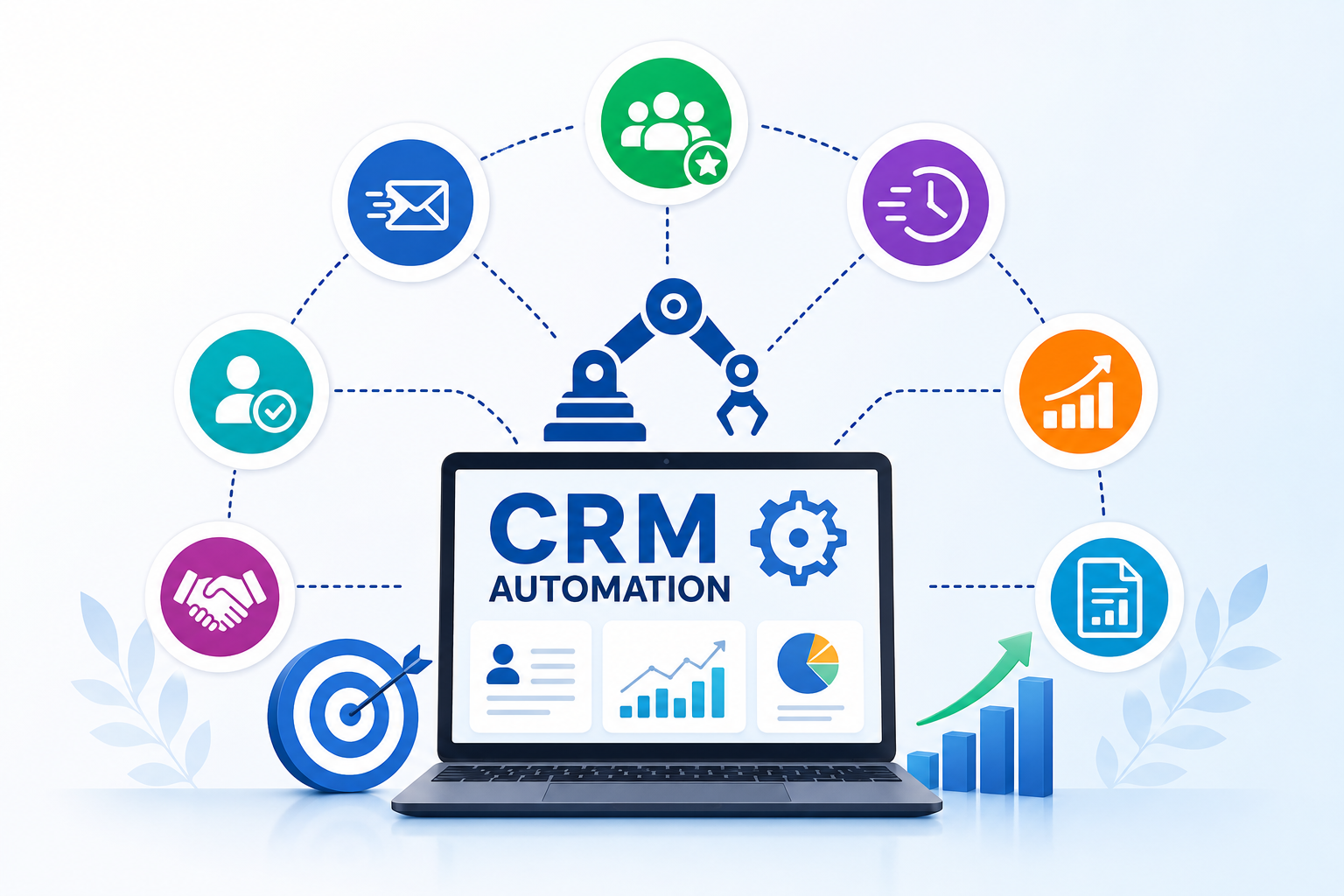
Customer Relationship Management (CRM) automation enables businesses to automate repetitive sales activities, streamline workflows, and create a more efficient sales process. By reducing manual effort, organizations can improve productivity, accelerate deal cycles, and deliver better customer experiences.
As businesses increasingly embrace digital transformation, CRM automation has become an essential component of modern sales strategies. If you’re exploring broader automation opportunities, you may also find value in our guide on AI Automation Explained: Everything Business Owners Need to Know (/ai-automation-explained-everything-business-owners-need-to-know).
According to industry insights from Salesforce (https://www.salesforce.com/resources/), sales professionals spend a significant portion of their workday on non-selling activities. CRM automation helps eliminate these inefficiencies, enabling teams to spend more time engaging with prospects and driving revenue growth.
In this comprehensive guide, we’ll explore how CRM automation increases sales productivity, its key benefits, implementation strategies, common challenges, and future trends.
What Is CRM Automation?
CRM automation refers to the use of software, workflows, and intelligent technologies to automate repetitive tasks within a Customer Relationship Management system.
Traditionally, sales teams manually handled activities such as:
- Lead assignment
- Contact management
- Follow-up scheduling
- Data entry
- Pipeline updates
- Report generation
CRM automation replaces these manual processes with predefined workflows that execute tasks automatically based on specific triggers.
For example, when a visitor fills out a contact form on your website, a CRM system can instantly:
- Create a customer profile
- Assign the lead to a sales representative
- Send a welcome email
- Schedule a follow-up task
- Update the sales pipeline
This automation significantly reduces delays and improves operational efficiency.
Many businesses implement CRM automation as part of a larger Digital Transformation Roadmap (/digital-transformation-roadmap-for-small-businesses) designed to modernize business operations and improve customer engagement.
Popular CRM platforms offering automation capabilities include:
- Salesforce CRM (https://www.salesforce.com/crm/)
- HubSpot CRM (https://www.hubspot.com/products/crm)
- Zoho CRM (https://www.zoho.com/crm/)
- Microsoft Dynamics 365
- Pipedrive CRM
Why Sales Productivity Matters
Sales productivity measures how effectively a sales team converts opportunities into revenue.
A productive sales team spends the majority of its time:
- Engaging with prospects
- Conducting sales calls
- Delivering demonstrations
- Negotiating deals
- Building customer relationships
Unfortunately, many sales representatives spend excessive time on administrative responsibilities that do not directly contribute to revenue generation.
Poor productivity often results in:
- Missed opportunities
- Slow lead response times
- Inconsistent follow-ups
- Lower conversion rates
- Reduced customer satisfaction
CRM automation addresses these challenges by streamlining workflows and enabling sales professionals to focus on high-value activities.
Organizations that implement CRM automation frequently experience:
- Increased selling time
- Faster deal closures
- Improved lead conversion rates
- Better customer retention
- Higher revenue growth
Key Ways CRM Automation Increases Sales Productivity
1. Eliminates Manual Data Entry
Manual data entry is one of the most significant productivity drains for sales teams.
Sales representatives often spend hours updating customer information, logging calls, tracking emails, and managing spreadsheets. Not only is this time-consuming, but it also increases the likelihood of human error.
CRM automation automatically captures information from:
- Website forms
- Email interactions
- Phone calls
- Chat conversations
- Customer activities
This ensures data accuracy while allowing sales professionals to dedicate more time to selling.
Benefits
- Saves time
- Reduces administrative workload
- Improves data quality
- Enhances reporting accuracy
- Provides better customer visibility
2. Automates Lead Management
Effective lead management is critical to sales success.
Without automation, leads may be assigned incorrectly, contacted too late, or forgotten altogether.
CRM automation helps organizations:
- Capture leads automatically
- Route leads to appropriate representatives
- Score leads based on behavior
- Segment prospects by interest level
- Trigger nurturing campaigns
For example, if a visitor downloads a resource from your website, the CRM can automatically categorize the lead and initiate a personalized email sequence.
Businesses seeking advanced lead qualification often combine CRM systems with AI Agents. Learn more in our guide: How AI Agents Are Transforming Modern Businesses (/how-ai-agents-are-transforming-modern-businesses).
3. Speeds Up Lead Response Time
Response speed plays a crucial role in lead conversion.
Studies consistently show that prospects are more likely to engage with businesses that respond quickly to inquiries.
CRM automation enables instant engagement through:
- Automated welcome emails
- Instant lead notifications
- Chatbot integrations
- Appointment scheduling tools
- SMS follow-up sequences
Tools such as Calendly (https://calendly.com/) can integrate with CRM platforms to simplify scheduling and reduce delays.
The faster a business responds, the greater the likelihood of converting a prospect into a customer.
4. Streamlines Follow-Up Processes
Many sales opportunities are lost due to inconsistent follow-up.
Prospective customers often require multiple touchpoints before making a purchasing decision. However, manually managing hundreds of follow-ups can be challenging.
CRM automation ensures consistent communication by:
- Scheduling follow-up emails
- Creating reminders
- Assigning tasks automatically
- Sending engagement notifications
A typical automated sequence might include:
- Day 1: Welcome email
- Day 3: Educational content
- Day 7: Case study
- Day 14: Product demonstration invitation
- Day 21: Consultation offer
Businesses looking to automate additional processes should explore Workflow Automation for Business Growth (/what-is-workflow-automation-and-why-does-your-business-need-it).
5. Improves Sales Pipeline Visibility
Sales managers require real-time visibility into the sales pipeline to make informed decisions.
CRM automation automatically updates pipeline stages based on:
- Customer interactions
- Meeting bookings
- Proposal submissions
- Contract approvals
- Purchase decisions
This provides accurate insights into:
- Active opportunities
- Conversion rates
- Sales forecasts
- Revenue projections
- Team performance
Improved visibility enables organizations to identify bottlenecks and optimize sales strategies more effectively.
6. Enhances Customer Personalization
Modern consumers expect personalized experiences.
CRM automation enables businesses to segment customers based on:
- Industry
- Company size
- Geographic location
- Purchase history
- Website behavior
- Engagement levels
This data can be used to deliver targeted messaging and relevant content.
For example, a prospect interested in automation services can automatically receive case studies, whitepapers, and educational resources related to business automation.
To learn more about personalized automation strategies, read our article on AI-Powered Marketing Trends Every Business Should Know (/ai-powered-marketing-trends-every-business-should-know).
7. Strengthens Team Collaboration
Sales success depends on effective collaboration between departments.
CRM automation improves communication between:
- Sales teams
- Marketing teams
- Customer support teams
- Operations departments
Centralized customer data ensures that everyone has access to the same information, creating a seamless customer experience from lead generation to post-sale support.
8. Generates Accurate Reports Automatically
Data-driven decision-making is essential for sustainable business growth.
CRM automation provides real-time reports on:
- Lead performance
- Sales activities
- Pipeline health
- Conversion metrics
- Revenue trends
Organizations can integrate CRM systems with Microsoft Power BI (https://powerbi.microsoft.com/) to build advanced dashboards and business intelligence reports.
Automated reporting eliminates manual spreadsheet management and provides actionable insights for business leaders.
Real-World Example of CRM Automation
Imagine a prospect visits your website and submits a contact form.
Without CRM Automation
- Sales representative reviews inquiry manually
- Lead information is entered into a spreadsheet
- Welcome email is sent manually
- Follow-up reminders are created manually
- Pipeline updates are performed manually
With CRM Automation
- Lead enters CRM instantly
- Lead is assigned automatically
- Welcome email is triggered
- Follow-up sequence begins automatically
- Tasks are generated instantly
- Pipeline stages update in real time
The entire process takes seconds instead of hours.
Common CRM Automation Mistakes to Avoid
While CRM automation offers tremendous benefits, businesses should avoid common implementation mistakes:
Automating Inefficient Processes
Automation should improve workflows—not automate existing inefficiencies.
Ignoring Data Quality
Poor-quality data leads to poor automation results.
Over-Automation
Customers still value human interactions. Automation should support, not replace, relationship-building.
Lack of Employee Training
Teams must understand how to use CRM systems effectively to maximize adoption and productivity.
The Future of CRM Automation
The future of CRM automation is increasingly powered by Artificial Intelligence.
Modern CRM platforms are introducing advanced capabilities such as:
- Predictive lead scoring
- AI-powered forecasting
- Customer sentiment analysis
- Automated conversation intelligence
- Personalized recommendations
- Smart workflow optimization
As AI technology continues to evolve, CRM systems will become even more intelligent, enabling businesses to anticipate customer needs and make more informed decisions.
Organizations that adopt AI-powered CRM automation today will be better positioned to compete in an increasingly digital marketplace.
Conclusion
CRM automation has evolved from a convenience into a business necessity.
By automating repetitive administrative tasks, improving lead management, accelerating response times, enhancing customer engagement, and providing actionable insights, CRM automation empowers sales teams to achieve higher levels of productivity and performance.
Whether you’re a startup looking to scale sales operations or an established enterprise seeking greater efficiency, CRM automation can deliver measurable improvements in both revenue growth and customer satisfaction.
At TechBliss Solutions, we help businesses implement CRM automation, AI-powered workflows, and intelligent sales systems that drive sustainable growth. If you’re ready to modernize your sales processes and unlock new opportunities, our team can help you design a solution tailored to your business goals.
Frequently Asked Questions (FAQs)
How does CRM automation increase sales productivity?
CRM automation reduces manual tasks such as data entry, lead assignment, and follow-ups, allowing sales representatives to focus on customer engagement and revenue-generating activities.
What are the main benefits of CRM automation?
The primary benefits include improved efficiency, faster response times, better lead management, increased customer satisfaction, enhanced reporting, and higher conversion rates.
Is CRM automation suitable for small businesses?
Yes. CRM automation helps small businesses streamline operations, improve customer communication, and scale sales efforts without significantly increasing staffing costs.
Which CRM platforms provide automation features?
Popular CRM platforms include Salesforce CRM, HubSpot CRM, Zoho CRM, Microsoft Dynamics 365, and Pipedrive.
Can CRM automation work with AI tools?
Absolutely. Modern CRM systems integrate with AI-powered solutions to provide predictive analytics, lead scoring, personalized recommendations, and intelligent workflow automation.