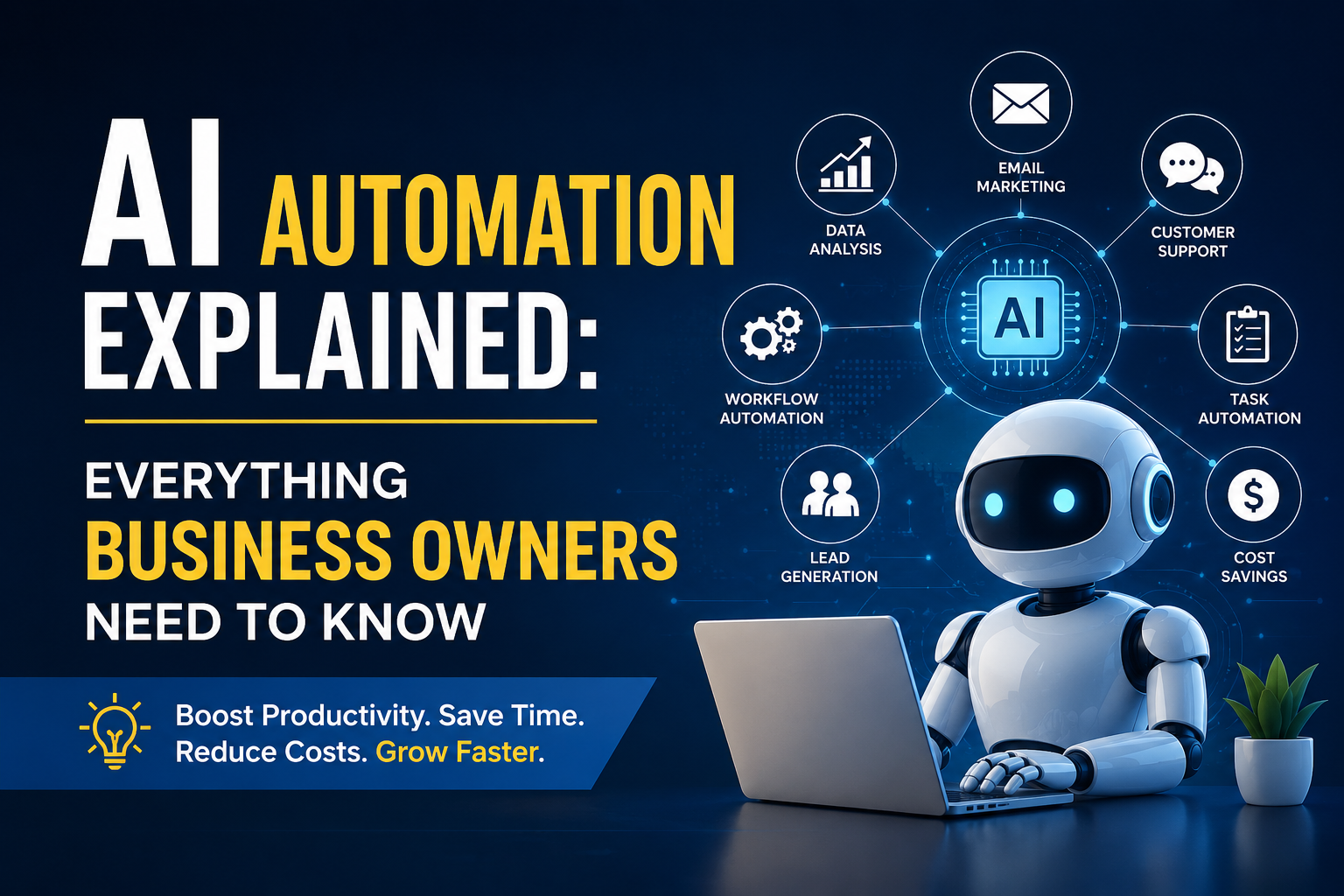
AI Automation Explained: Everything Business Owners Need to Know
In today’s fast-paced digital world, small businesses face increasing pressure to do more with fewer resources. Business owners juggle customer support, sales, marketing, operations, invoicing, scheduling, and countless administrative tasks every day. While these responsibilities are necessary, they often consume valuable time that could be spent growing the business.
This is where AI automation is making a significant impact.
AI automation is transforming how businesses operate by automating repetitive processes, improving decision-making, enhancing customer experiences, and enabling teams to focus on strategic growth. What was once considered enterprise-level technology is now accessible to businesses of all sizes through affordable and user-friendly platforms.
Whether you’re a startup founder, local business owner, agency operator, or growing company, understanding AI automation can give you a competitive advantage.
In this comprehensive guide, we’ll explore what AI automation is, its benefits, practical use cases, top tools, implementation strategies, and how businesses can leverage AI to scale efficiently in 2026 and beyond.
What Is AI Automation?
AI automation refers to the combination of artificial intelligence technologies and workflow automation systems to perform tasks with minimal human intervention.
Traditional automation follows predefined rules and instructions. AI automation goes a step further by incorporating machine learning, natural language processing, predictive analytics, and intelligent decision-making capabilities.
This allows systems to:
- Learn from historical data
- Recognize patterns
- Understand human language
- Make recommendations
- Improve performance over time
- Automate complex workflows
For example, a traditional automation workflow may send a welcome email when a customer submits a contact form. An AI-powered automation workflow can analyze the inquiry, determine customer intent, prioritize the lead, draft a personalized response, and automatically schedule a follow-up task.
Traditional Automation vs AI Automation
| Feature | Traditional Automation | AI Automation |
|---|---|---|
| Rule-Based Processes | Yes | Yes |
| Learns From Data | No | Yes |
| Handles Unstructured Data | Limited | Excellent |
| Natural Language Understanding | No | Yes |
| Predictive Analytics | No | Yes |
| Intelligent Decision Making | No | Yes |
| Continuous Improvement | No | Yes |
As businesses generate more data and customer interactions become increasingly complex, AI automation provides the flexibility needed to scale efficiently.
Why AI Automation Matters for Small Businesses
Many small businesses operate with limited staff and resources. Employees often spend hours performing repetitive tasks that could easily be automated.
Common examples include:
- Responding to customer inquiries
- Scheduling appointments
- Sending follow-up emails
- Updating CRM records
- Processing invoices
- Managing social media content
- Generating reports
These activities are important but don’t directly contribute to growth.
AI automation helps businesses reclaim valuable time while improving operational efficiency.
Key Benefits of AI Automation
1. Increased Productivity
One of the biggest advantages of AI automation is increased productivity.
When repetitive tasks are automated, employees can focus on:
- Strategic planning
- Customer relationships
- Business development
- Revenue-generating activities
Instead of manually entering data for hours, teams can focus on solving problems and creating value.
2. Reduced Operational Costs
Manual processes require time, labor, and resources.
AI automation reduces costs by:
- Eliminating repetitive work
- Reducing human error
- Increasing workflow efficiency
- Minimizing administrative overhead
Businesses can accomplish more without significantly increasing staffing costs.
3. Improved Customer Experience
Modern customers expect fast responses and personalized interactions.
AI-powered systems can:
- Provide instant support
- Route inquiries intelligently
- Personalize communications
- Deliver consistent customer experiences
This leads to higher satisfaction rates and improved customer retention.
4. Better Decision-Making
AI tools analyze large volumes of data quickly and accurately.
Business owners gain insights into:
- Customer behavior
- Sales trends
- Marketing performance
- Operational bottlenecks
These insights help leaders make informed decisions backed by data.
5. Scalability
As businesses grow, manual processes often become bottlenecks.
AI automation enables organizations to handle increasing workloads without proportional increases in staff or operational complexity.
Real-World AI Automation Examples
AI automation is already transforming businesses across industries.
Customer Support Automation
AI chatbots and virtual assistants can answer frequently asked questions, provide product information, and assist customers around the clock.
Benefits include:
- Faster response times
- Reduced support workload
- 24/7 availability
- Improved customer satisfaction
Lead Generation and Qualification
AI can automatically:
- Capture leads from websites
- Analyze customer intent
- Score prospects
- Route qualified leads to sales teams
This ensures sales representatives focus on high-value opportunities.
Email Marketing Automation
AI-powered marketing tools help businesses:
- Segment audiences
- Personalize content
- Optimize send times
- Improve engagement rates
Automated email campaigns nurture leads while saving time.
Appointment Scheduling
AI scheduling assistants eliminate back-and-forth communication by:
- Checking availability
- Booking appointments
- Sending reminders
- Managing calendar updates
Invoice Processing
AI can extract data from invoices, validate information, and synchronize records with accounting systems.
This significantly reduces administrative work and minimizes errors.
Social Media Automation
Businesses can automate:
- Content scheduling
- Performance monitoring
- Audience engagement
- Reporting
AI tools also assist with content creation and optimization.
Best AI Automation Tools for Small Businesses
Choosing the right tools is critical for successful implementation.
1. n8n
n8n is a powerful workflow automation platform that enables businesses to connect applications and automate processes.
Key Features:
- Open-source flexibility
- Advanced workflow customization
- API integrations
- AI-powered automation capabilities
Best For:
Businesses seeking cost-effective and highly customizable automation solutions.
2. Zapier
Zapier connects thousands of applications without coding.
Key Features:
- Easy setup
- Large integration ecosystem
- Workflow templates
- User-friendly interface
Best For:
Small businesses looking for quick and simple automation.
3. Make
Make provides visual workflow building for advanced automation scenarios.
Key Features:
- Visual workflow designer
- Complex logic handling
- Multi-step automation
- Advanced integrations
Best For:
Businesses requiring sophisticated workflows.
4. OpenAI
OpenAI enables businesses to integrate powerful AI capabilities into their operations.
Key Features:
- Content generation
- Customer support automation
- Data analysis
- AI-powered assistants
Best For:
Organizations implementing AI-driven customer experiences.
5. Microsoft Copilot
Microsoft Copilot enhances productivity within Microsoft ecosystems.
Key Features:
- Document automation
- Meeting summaries
- Data analysis
- Workflow assistance
Best For:
Businesses are already using Microsoft products.
How to Implement AI Automation Successfully
Step 1: Identify Repetitive Tasks
Start by listing tasks that:
- Consume significant time
- Follow predictable patterns
- Require minimal human judgment
Examples include:
- Data entry
- Lead follow-ups
- Appointment scheduling
- Report generation
Step 2: Prioritize High-Impact Areas
Focus on processes that:
- Generate revenue
- Improve customer experience
- Reduce costs
Quick wins create momentum and demonstrate value.
Step 3: Select Appropriate Tools
Choose tools based on:
- Budget
- Technical requirements
- Integration needs
- Business objectives
Avoid implementing technology solely because it’s popular.
Step 4: Build and Test Workflows
Begin with one process.
For example:
Website Form → AI Lead Analysis → CRM Update → Sales Notification
Monitor results and optimize performance.
Step 5: Scale Gradually
Expand automation initiatives based on measurable success.
Continuous improvement leads to better outcomes over time.
Common Challenges and Solutions
Data Quality Issues
Poor data can negatively impact automation performance.
Solution:
Maintain clean, accurate, and standardized data.
Integration Challenges
Businesses often use multiple software platforms.
Solution:
Use integration-friendly tools with robust API capabilities.
Employee Adoption
Some employees may worry about automation.
Solution:
Position AI as a productivity enhancer rather than a replacement.
Security Concerns
Protecting customer data is essential.
Solution:
Implement strong security practices and choose reputable providers.
Future Trends in AI Automation
The future of AI automation is rapidly evolving.
Key trends include:
AI Agents
AI agents can independently complete multi-step tasks with minimal supervision.
Hyperautomation
Organizations are combining AI, machine learning, and robotic process automation to automate entire business functions.
Personalized Experiences
AI enables businesses to deliver highly personalized interactions at scale.
Predictive Operations
Businesses increasingly use AI to anticipate customer needs and operational challenges before they occur.
Why Businesses Should Adopt AI Automation Now
The competitive landscape is changing rapidly.
Businesses that adopt AI automation gain advantages such as:
- Faster operations
- Lower costs
- Better customer experiences
- Increased scalability
- Improved profitability
Those who delay implementation risk falling behind competitors that operate more efficiently.
AI automation is no longer a future trend—it is a present-day business necessity.
How TechBliss Helps Businesses Automate and Scale
At TechBliss, we help businesses leverage AI automation to streamline operations, improve efficiency, and drive growth.
Our services include:
AI Workflow Automation
Automate repetitive processes across your organization.
CRM Automation
Optimize lead management, customer engagement, and sales workflows.
AI-Powered Lead Generation
Generate, qualify, and nurture leads automatically.
Custom AI Solutions
Build tailored automation systems designed around your business objectives.
Business Process Optimization
Identify inefficiencies and implement scalable solutions that improve performance.
Whether you’re just beginning your automation journey or looking to scale existing systems, TechBliss can help you unlock measurable business value through AI-driven transformation.
Ready to Transform Your Business with AI Automation?
The businesses that thrive in the coming years will be those that embrace automation and innovation today.
AI automation offers an opportunity to:
- Save valuable time
- Increase productivity
- Reduce costs
- Improve customer experiences
- Generate more qualified leads
- Scale without operational chaos
If you’re ready to explore how AI automation can transform your business, TechBliss can help.
Contact TechBliss today for a free consultation and discover how intelligent automation can accelerate your growth.
Frequently Asked Questions
What is AI automation?
AI automation combines artificial intelligence and workflow automation to perform tasks, analyze data, and make decisions with minimal human involvement.
How can small businesses benefit from AI automation?
Small businesses can improve productivity, reduce costs, enhance customer experiences, and scale operations more efficiently.
Is AI automation expensive?
Many AI automation tools offer affordable pricing plans suitable for businesses of all sizes.
What are the best AI automation tools?
Popular options include n8n, Zapier, Make, OpenAI, and Microsoft Copilot.
Can AI automation replace employees?
AI primarily automates repetitive tasks, allowing employees to focus on strategic and creative work.
How long does implementation take?
Simple automation workflows can be deployed within days, while larger projects may require several weeks.
Is AI automation secure?
Yes, when implemented using reputable platforms and proper security practices.
What processes can be automated?
Customer support, lead generation, invoicing, scheduling, marketing, CRM management, reporting, and many other business functions can be automated.
Ready to automate your business? Contact TechBliss today and take the first step toward smarter growth with AI automation.